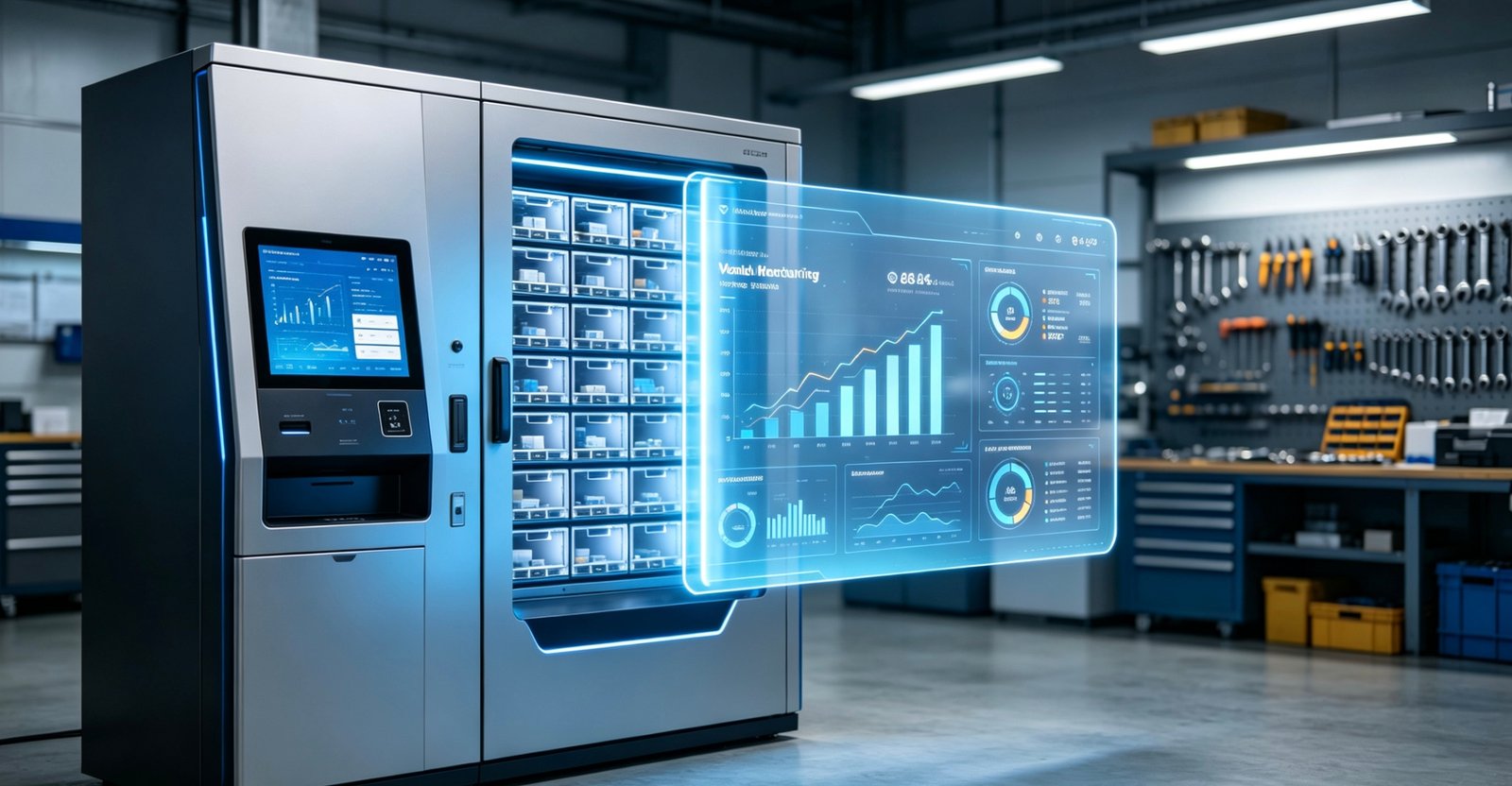
Industrial Vending Machine vs Traditional Tool Crib
For many years, the traditional tool crib has been the standard method for managing tools, PPE, cutting tools, and maintenance supplies in manufacturing facilities. However, with increasing pressure to improve efficiency and reduce operational costs, more companies are turning to industrial vending machines.
1. Traditional Tool Crib
The traditional tool crib relies heavily on personnel to manage inventory, issue tools, and track consumption manually or through legacy barcode systems. While established, it presents distinct operational dynamics.
Advantages
- Familiar management process for veteran staff
- Suitable for small inventories with low turnover
- Flexible handling of irregularly shaped or uniquely oversized items
Challenges
- High labor costs to staff the crib across multiple shifts
- Limited access outside standard working hours
- Manual inventory tracking leading to human error
- Higher risk of stock shortages and overstocking blind spots
- Difficult to identify individual consumption patterns or abuse
2. Industrial Vending Machine
Industrial vending systems digitize and automate the entire point-of-use inventory process, providing secure, accountable access right where work happens on the shop floor.
Advantages
3. Key Differences at a Glance
| Feature | Traditional Tool Crib | Industrial Vending Machine |
|---|---|---|
| Inventory Tracking | Manual or delayed scanning | 100% Automated & Real-time |
| Access Control | Visual check / Sign-out sheets | Biometrics, RFID, PIN, or Barcode |
| Availability | Limited to staffed shift hours | 24/7 Uninterrupted access |
| Data Collection | Prone to human error, slow to compile | Instant, accurate, API-ready data |
| Labor Requirement | High (Requires dedicated crib attendant) | Low (Self-serve, automated alerts) |
| Consumption Control | Low visibility on per-user basis | Hard limits per user/department/shift |
4. Which Solution is Right for You?
Deciding between a traditional tool crib and an industrial vending machine comes down to your organizational needs. If you have a highly specialized, low-turnover inventory with large or uniquely shaped items, a traditional or hybrid tool crib may still serve a purpose. However, modern manufacturing environments facing demands for lean operations, accurate cost-tracking, shift flexibility, and minimal waste will find that an industrial vending machine dramatically outperforms the traditional approach.
Conclusion
Industrial vending machines are transforming manufacturing by turning inventory management into an automated, data-driven advantage. While the traditional tool crib has its legacy, the future of smart manufacturing lies in intelligent point-of-use distribution. By transitioning to automated vending, facilities not only secure their assets but empower their workforce to operate at peak efficiency.