October 23, 2026
How to Choose the Right Industrial Vending Hardware for Your Own Software Platform
Choosing industrial vending hardware is about more than storage capacity. Discover the key factors system integrators should consider when connecting vending machines to their own inventory management software.
Industrial Vending Is More Than a Standalone Machine
For many industrial inventory solution providers, the vending machine is only one component of a larger system.
The complete solution may involve employee identification, dispensing permissions, inventory records, replenishment management, and integration with existing business software.
When a customer already has its own software platform, choosing suitable vending hardware becomes an important technical and commercial decision.
1. Understand the Hardware Communication Interface
One of the first questions is how the machine communicates with the customer's application.
Some industrial vending systems are designed around a complete proprietary software package. Others offer hardware communication interfaces that allow system integrators to develop their own applications.
JIEMA's JM-S-768e rotating drum industrial vending machine supports a low-level communication approach for customer-developed software.
This enables system integrators to evaluate the hardware as part of their own industrial inventory solution, rather than necessarily adopting a complete software platform from the machine manufacturer.
2. Evaluate Storage Capacity and Compartment Flexibility
Industrial materials vary significantly in size and packaging.
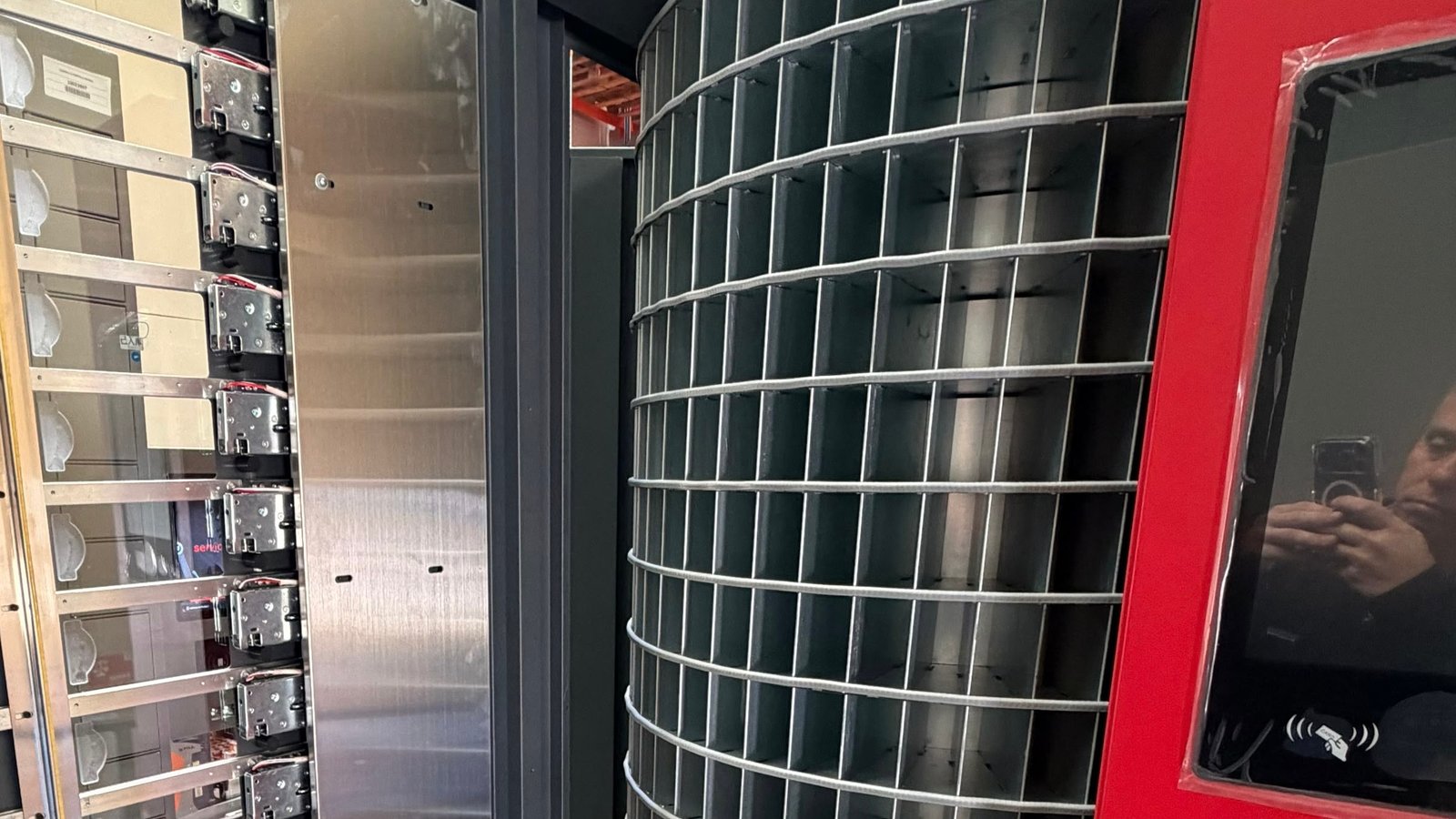
The JM-S-768e features 16 storage layers and supports up to 768 compartments in its maximum-density configuration.
Its modular rotating drum design also allows adjacent storage segments to be combined, creating larger compartments for different products.
Typical configurations include 48, 24, or 16 compartments per layer.
For system integrators, this flexibility can help accommodate different customer applications using the same fundamental rotating storage architecture.
3. Consider Identification and Peripheral Requirements
Industrial vending projects often require different methods of identifying authorized users.
Depending on the application, these may include employee cards, QR codes, NFC, RFID tags, or facial recognition.
The JM-S-768e supports different peripheral configurations, with optional equipment subject to project requirements and technical compatibility.
System integrators should confirm the selected peripherals, communication methods, and software responsibilities before finalizing the hardware specification.
4. Define Software Responsibilities Clearly
A successful integration project requires a clear division of responsibilities between the hardware manufacturer and software provider.
JIEMA offers different cooperation approaches:
Mode A — Low-Level Protocol Integration
JIEMA supplies the vending hardware and applicable low-level communication protocol, while the customer develops the host application and business software.
Mode B — HTTP API Integration
An HTTP-based integration arrangement may be evaluated according to the project's architecture and development requirements.
Mode C — Customized Software Solution
A broader software solution may be discussed when the customer requires additional development or a more complete system.
The availability, scope, cost, and delivery schedule of each approach should be confirmed for the individual project.
5. Plan for Customization and Future Deployment
Hardware selection should also consider the practical requirements of future deployment.
These may include cabinet branding, identification peripherals, compartment dimensions, installation conditions, electrical compatibility, and maintenance arrangements.
JIEMA supports OEM and ODM discussions for industrial vending projects, allowing partners to evaluate configurations suited to their markets and end users.
A Hardware Platform for System Integrators
The JM-S-768e belongs to JIEMA's JM-S rotating carousel product series.
Across this product family, more than 2,000 units have been deployed in Mainland China for applications including banking, power utilities, healthcare, and manufacturing.
The JM-S series shares a common rotating carousel storage architecture, with configurations adapted to different industry requirements.
For companies developing their own industrial inventory software, choosing compatible hardware and defining integration responsibilities early can help create a clearer path from development and testing to deployment.
Explore JIEMA Industrial Vending Hardware
JIEMA works with system integrators and OEM partners to evaluate industrial vending hardware, compartment configurations, identification peripherals, and software integration requirements.
Contact JIEMA to discuss your project and learn more about the JM-S-768e rotating drum industrial vending machine.