November 21, 2026
Beyond Compartment Count: How to Configure Industrial Vending Machines for Different Materials
Is a higher compartment count always better for an industrial vending machine? This article explains how compartment width, height, load capacity, and material dimensions influence the configuration of an industrial vending machine.
More Compartments Do Not Always Mean Better Storage
When comparing industrial vending machines, storage capacity is often one of the first parameters customers focus on.
A machine with several hundred compartments may appear more attractive than one with fewer compartments.
However, the actual value of an industrial vending machine depends on whether its compartments can meet the storage requirements of the materials the customer needs to manage.
Cutting tools, personal protective equipment (PPE), spare parts, and maintenance consumables can vary significantly in size, shape, and weight.
For industrial product distributors and VMI solution providers, selecting the right compartment configuration is usually more important than simply pursuing the highest possible compartment count.
Understanding the JM-S-768e Rotating Drum Architecture
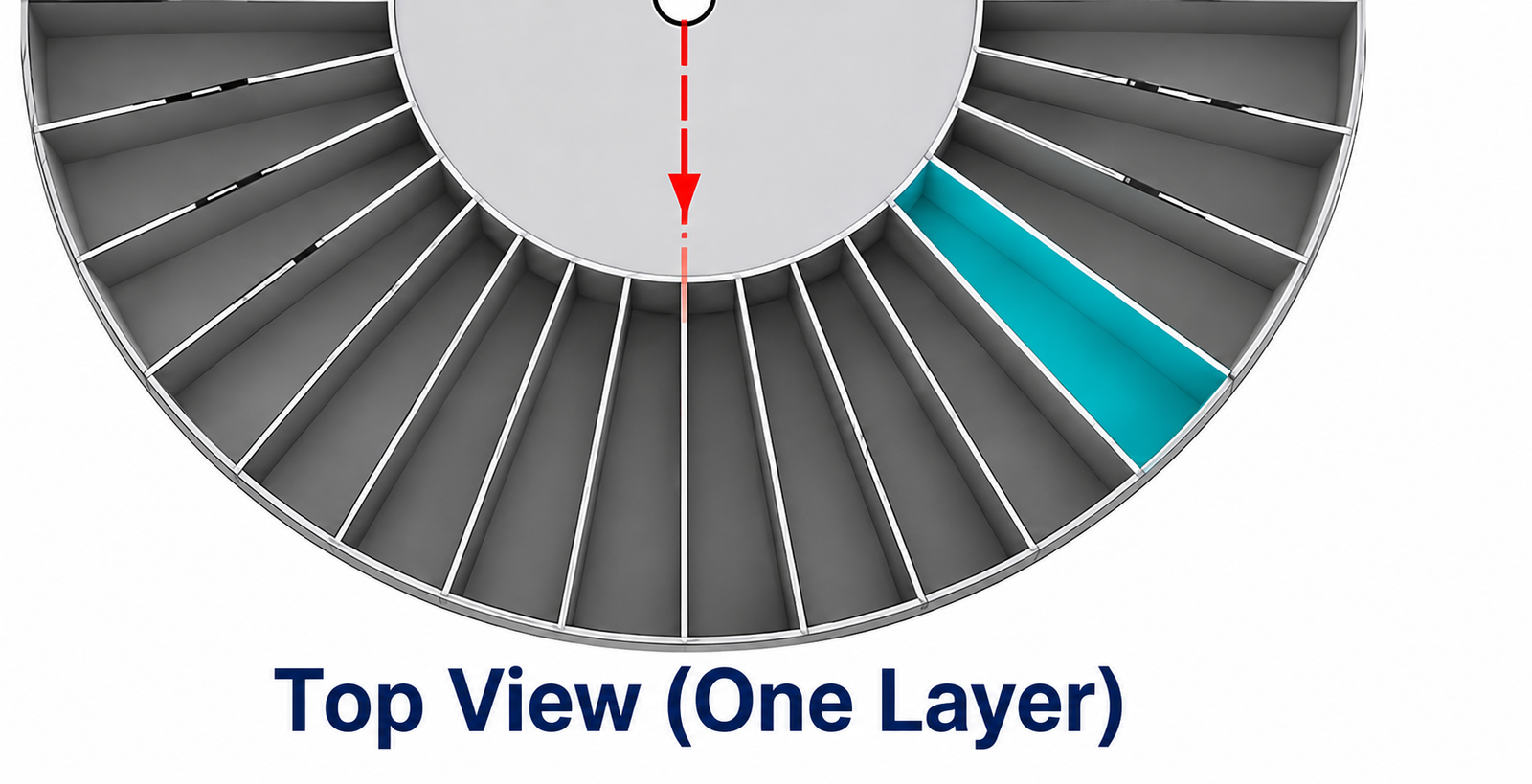
The JIEMA JM-S-768e uses a rotating drum storage architecture.
In its maximum-density configuration, the machine has 16 storage layers with 48 compartments per layer, providing up to 768 independent storage locations.
The modular compartment design allows adjacent compartments to be combined to store larger materials. The three typical configurations are:
| Configuration | Compartments per Layer | Nominal Compartment Width |
|---|---|---|
| Type 1 | 48 | 49 mm |
| Type 2 | 24 | 99 mm |
| Type 3 | 16 | 149 mm |
These configurations illustrate the relationship between compartment count and the available storage width.
Combining adjacent compartments increases the storage width, but the number of independent compartments is reduced accordingly.
Compartment Height Must Be Planned Before Production
Storage width is only one aspect of compartment configuration.
Certain industrial materials require greater vertical space, so compartment height is equally important.
The JM-S-768e supports customized storage layer configurations during the manufacturing stage, including combining the height of multiple standard layers to obtain greater storage height.
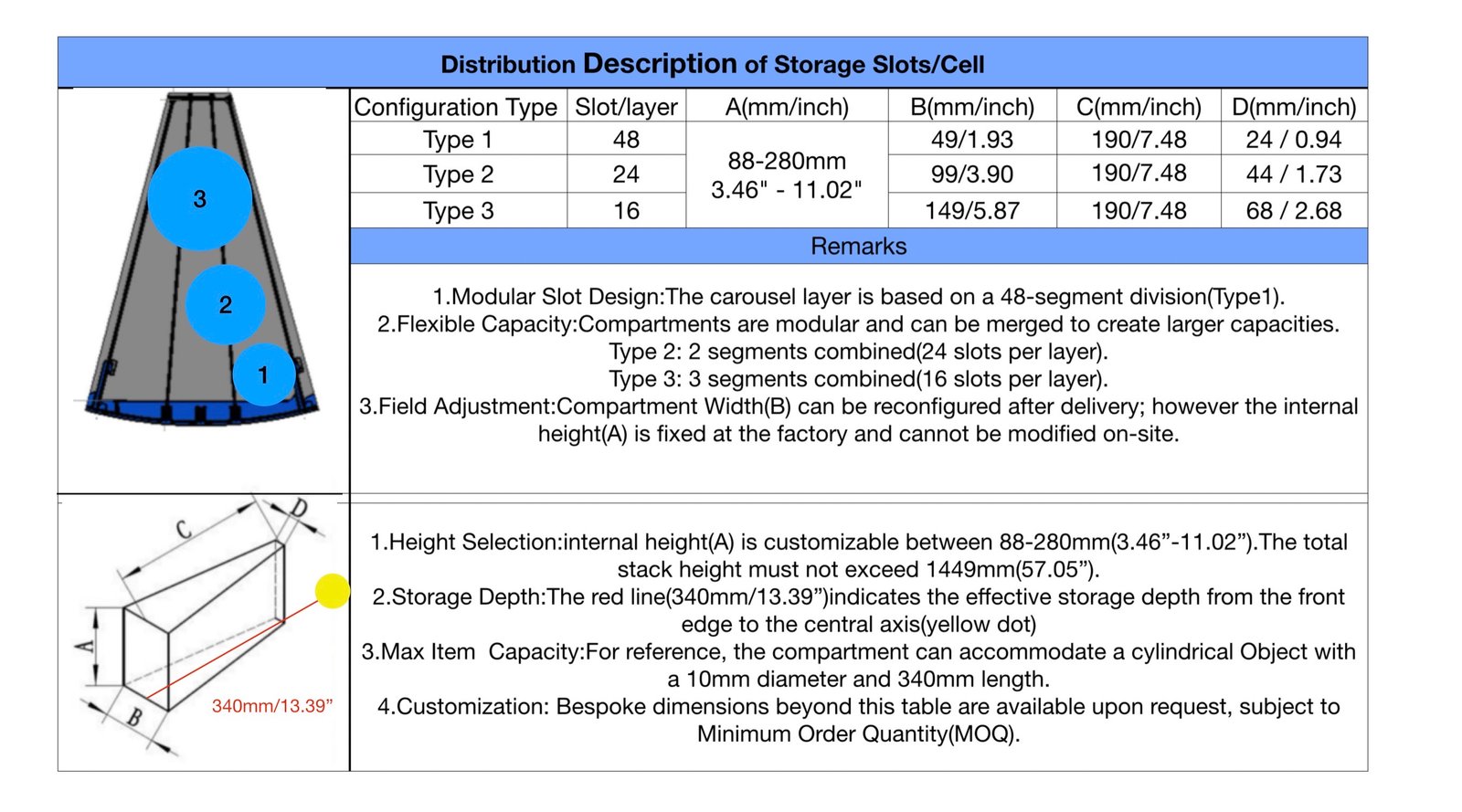
An important distinction is that compartment width can be adjusted after delivery by combining adjacent compartments, while the layer height configuration must be determined before production.
This is particularly important for system integrators that need to store materials of different heights.
Load Capacity Is Also an Important Selection Factor
In its standard configuration, the JM-S-768e specifies a maximum load of 0.5 kg per compartment.
Before selecting a compartment configuration, customers need to evaluate the weight, size, and packaging form of the materials they plan to store.
It should not be assumed that combining compartments will automatically increase the permitted load.
For heavier or unusually shaped materials, the applicable storage structure and load limits should be confirmed with JIEMA during the project evaluation stage.
How to Choose the Right Compartment Configuration
A sound configuration process should start from material requirements, not from the machine model.
System integrators should first collect the following information:
- Maximum overall dimensions and packaging size of the materials
- Weight of a single item
- Number of independent storage locations required
- Expected range of material types to be managed
- User access and dispensing operation requirements
- Likelihood of future changes to material types
With this information in hand, the hardware manufacturer and system integrator can jointly evaluate compartment width, layer height, and the overall machine configuration.
Flexible Hardware for Different Industrial Scenarios
The JM-S-768e belongs to the JIEMA JM-S series of rotating drum industrial vending machines.
Its modular storage structure allows the machine to be configured for different industrial inventory management needs, such as cutting tools, PPE, spare parts, and production consumables.
For VMI software developers and OEM partners, this flexibility means solutions can be developed for different end customers on the basis of the same rotating drum architecture.
In addition, under the Model A cooperation model, JIEMA provides RS-485 low-level communication protocol documentation to partners developing their own host applications. This allows partners to evaluate hardware configuration and software integration requirements together during the project planning stage.
Choose the Machine Based on the Material, Not Just the Compartment Count
The industrial vending machine best suited to a customer is not necessarily the one with the highest nominal compartment count.
What matters more is whether the machine's storage structure, load limits, hardware interfaces, and operating method match the actual application requirements.
JIEMA can work with industrial product distributors, system integrators, and OEM partners to evaluate these requirements together and determine the appropriate configuration before production.
Planning an industrial vending project?
Contact JIEMA to discuss material dimensions, compartment configuration, and software integration requirements.