November 16, 2026
From Development Kit to Deployment: Integrating Industrial Vending Hardware with Your Own Software
Already have your own VMI or inventory management software? Discover how a development kit, RS-485 communication protocol, and structured integration testing can help you evaluate industrial vending hardware before committing to a full machine deployment.
The First Challenge Is Not Buying the Machine
For VMI software providers and industrial system integrators, introducing a new industrial vending machine is not simply a hardware purchasing decision.
Before deploying equipment at a customer's facility, the software team needs to understand how the machine operates, how commands are exchanged, and how hardware behavior can be integrated into existing inventory workflows.
Purchasing a complete vending machine before validating the integration may introduce unnecessary cost and development uncertainty.
A more structured approach is to begin with hardware communication testing, followed by application development and full-machine validation.
Step 1: Define the Software and Hardware Responsibilities
The first step is to establish a clear integration boundary.
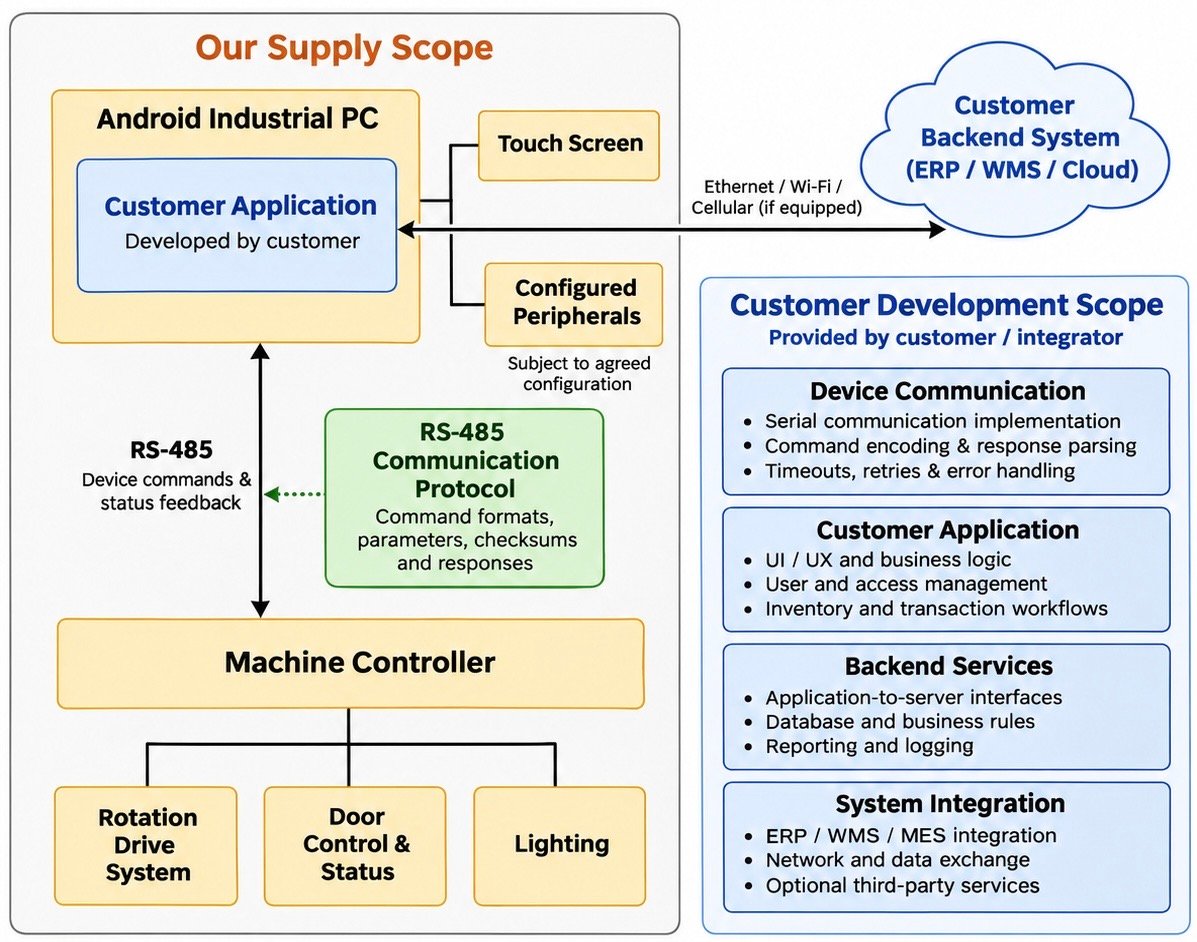
Under JIEMA's Mode A cooperation model, JIEMA supplies the industrial vending hardware and its applicable low-level RS-485 communication protocol.
The customer is responsible for developing its own host application, user interface, inventory management functions, and business workflows.
This approach is particularly relevant to companies that already have their own VMI software platform and development team.
It allows the software provider to retain control over its application while integrating a dedicated industrial vending hardware platform.
Step 2: Start with a Development Kit
A development kit provides a practical way to begin evaluating the hardware communication interface before purchasing a complete machine.
Depending on the supplied kit configuration, developers can use it to study the communication protocol, develop control functions, and verify the interaction between their application and the hardware control components.
Typical early development objectives include:
- Establishing reliable RS-485 communication
- Implementing supported hardware control commands
- Interpreting device responses and error conditions
- Developing the host application interface
- Preparing the software for subsequent machine-level testing
The development kit is intended for preliminary integration work. It does not replace the mechanical, electrical, and operational validation required on a complete vending machine.
Step 3: Understand the JM-S-768e Hardware Architecture
The JIEMA JM-S-768e is a rotating drum industrial vending machine featuring 16 storage layers and a maximum configuration of 768 compartments.
Its storage architecture supports different compartment arrangements, including 48, 24, or 16 compartments per layer.
For software developers, the integration process involves more than sending a dispensing command.
The application must coordinate the supported hardware operations with the customer's inventory management logic and user interaction process.
The low-level communication protocol provides the foundation for this interaction, while the customer's software determines how the equipment fits into its broader business system.
Step 4: Validate the Complete Machine
Once the basic communication functions have been developed, the next stage is integration testing with the complete vending machine.
This stage should verify the behavior of the actual mechanical and electrical system under representative operating conditions.
Important testing areas may include:
- Rotating carousel positioning and dispensing operations
- Door control and safety interlocks
- Hardware status and error handling
- Identification peripherals included in the project configuration
- Application behavior during interruptions and recovery
- End-to-end inventory transaction workflows
The specific test plan should be agreed upon according to the selected hardware configuration and the customer's application requirements.
Step 5: Prepare for Customer Deployment
Successful laboratory communication testing is only one milestone.
Before deploying equipment to an end-user site, partners should confirm the final machine configuration, software compatibility, installation requirements, technical support responsibilities, and acceptance testing procedures.
For OEM partners, this stage may also involve branding, peripheral selection, and other project-specific hardware customization.
A structured development process helps both parties identify technical issues before expanding to additional machines or customer locations.
A Practical Cooperation Model for Software Companies
JIEMA supports different integration arrangements, but Mode A is especially suitable for partners with established software development capabilities.
The combination of a development kit, low-level communication documentation, and a configurable rotating drum machine gives software companies a practical path for evaluating hardware integration.
Rather than replacing the customer's software platform, JIEMA can supply the physical vending hardware and support the agreed technical integration scope.
Build Your Industrial Vending Solution with JIEMA
Are you a VMI software provider, industrial distributor, or system integrator planning to introduce industrial vending hardware?
Contact JIEMA to discuss the JM-S-768e, available development kit configurations, RS-485 communication documentation, and the technical requirements of your integration project.