November 23, 2026
Industrial Vending Machine Safety: Why Door Interlocks and Reliable Positioning Matter
In a rotating industrial vending machine, reliable operation depends on more than storage capacity. Explore how door interlocks, carousel positioning, and coordinated hardware control contribute to safe and predictable dispensing operations.
Safety Begins with Hardware Design
Industrial vending machines are designed to manage tools, spare parts, PPE, and other industrial consumables.
For rotating carousel machines, the storage mechanism must move to the required compartment while coordinating with the dispensing door and control system.
This makes mechanical design, motion control, and door status management important parts of the equipment architecture.
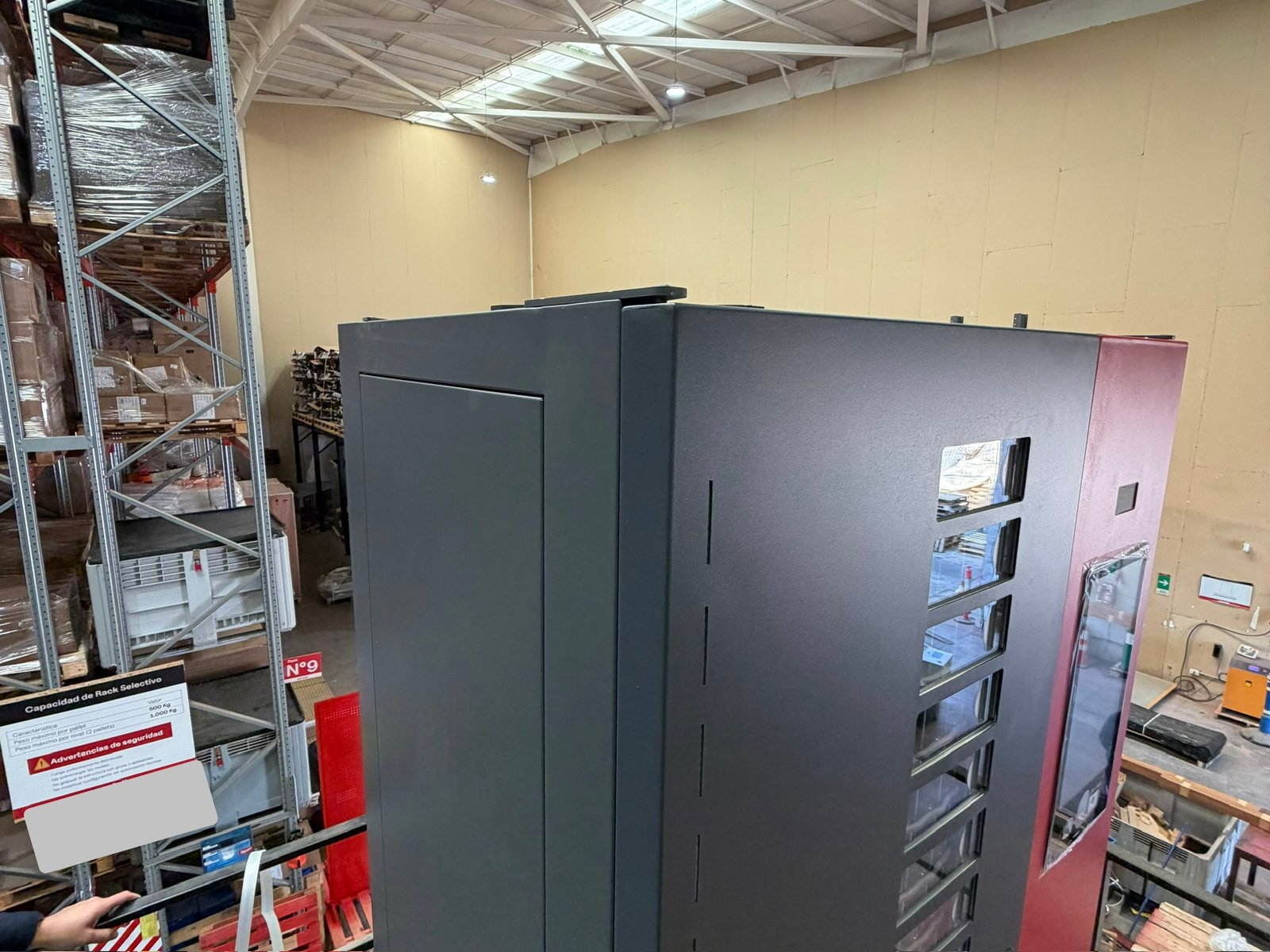
The JIEMA JM-S-768e Drum Industrial Vending Machine combines a rotating storage structure with servo-driven positioning and door control.
1. Door Interlocks: Preventing Rotation While the Door Is Open
One of the fundamental control requirements of a rotating vending machine is preventing carousel movement when the dispensing door is open.
The JM-S-768e incorporates a door interlock mechanism designed to prohibit carousel rotation while the door is open.
This helps separate the user's access operation from the machine's rotating movement.
The application and hardware controller must coordinate the dispensing sequence so that movement and door access occur in the correct order.
Door interlocks are an important protective measure, but they do not replace proper installation, operational procedures, or a complete safety assessment.
2. Servo-Driven Positioning: Reaching the Correct Compartment
A rotating carousel must position the selected compartment at the dispensing opening.
The JM-S-768e uses a servo-driven rotating mechanism and a defined home position as the reference for positioning.
The controller operates the carousel using position-based commands to reach the intended storage location.
For system integrators, reliable positioning is essential because physical dispensing operations must correspond to the compartment selected by the software.
Positioning behavior should be validated during complete-machine integration testing.
3. Hardware Control and Software Coordination
For companies developing their own VMI applications, understanding the division between low-level hardware control and application-level business logic is essential.
Under JIEMA's Mode A cooperation model, JIEMA provides the vending hardware and its applicable RS-485 communication protocol.
The customer develops the host application, user interface, inventory management logic, and other required software functions.
The software must coordinate its commands with the equipment's supported operating sequence and handle hardware responses appropriately.
A successful integration should not assume that sending a command alone guarantees that the requested mechanical operation has been completed.
4. What Should Be Tested Before Deployment?
Before an industrial vending machine is deployed at a customer site, the complete hardware and software system should undergo integration testing.
Important test areas include:
- Carousel homing and positioning
- Door opening and closing sequences
- Interlock behavior during door access
- Communication interruptions and error responses
- Recovery after unexpected operational interruptions
- Consistency between physical dispensing and inventory records
The detailed test plan should reflect the final machine configuration and the intended application.
5. Safety and Reliability Are Shared Project Responsibilities
A reliable industrial vending solution requires coordination between the hardware manufacturer, software developer, and system integrator.
The hardware provides the mechanical and electrical control foundation.
The application manages the user interaction and business workflow.
Installation, commissioning, and operational procedures must also be appropriate for the deployment environment.
Clearly defining these responsibilities helps reduce integration risks and supports more predictable equipment operation.
A Hardware Platform for Industrial Vending Integrators
The JM-S-768e features 16 storage layers and supports up to 768 compartments in its maximum-density configuration.
Its rotating carousel architecture supports different compartment arrangements for industrial tools, spare parts, PPE, and other consumables.
JIEMA works with VMI software providers, industrial distributors, and OEM partners to evaluate hardware configurations and integration requirements.
For partners with their own development teams, Mode A offers a way to integrate JIEMA hardware using the documented low-level communication interface.
Discuss Your Industrial Vending Project
Are you developing an industrial vending application or evaluating rotating carousel hardware for your existing VMI platform?
Contact JIEMA to discuss the JM-S-768e hardware architecture, RS-485 communication protocol, available configurations, and integration testing requirements.