November 2, 2026
Industrial Vending Machine Integration: 5 Questions to Ask Before Choosing a Hardware Supplier
Planning to integrate industrial vending machines with your own inventory software? Here are five essential questions about communication protocols, storage flexibility, user identification, software responsibilities, and maintenance.
Choosing Hardware Is Also an Integration Decision
For industrial distributors, VMI software providers, and system integrators, selecting an industrial vending machine involves more than comparing storage capacity, dimensions, or price.
The equipment must fit the customer's inventory workflows, support the required identification methods, and communicate reliably with the software platform.
Before choosing a hardware supplier, five questions deserve particular attention.
1. Can the Machine Communicate with Our Existing Software?
A hardware supplier should clearly explain which communication interfaces are available and what functions they support.
For companies developing their own software, access to a documented low-level protocol can be particularly valuable.
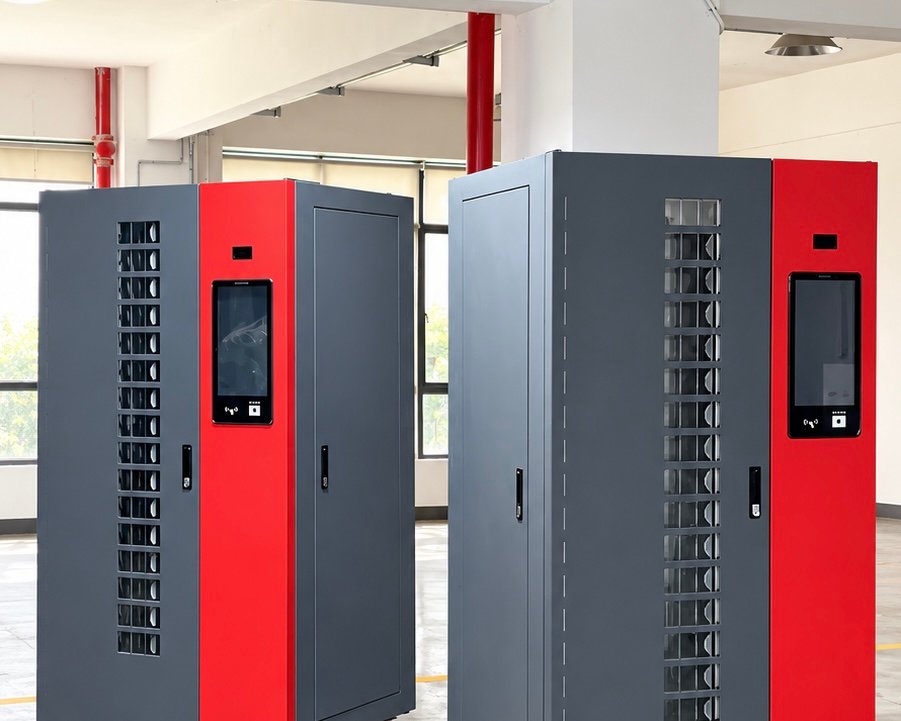
JIEMA's JM-S-768e Drum Industrial Vending Machine supports hardware integration through its low-level RS-485 communication protocol.
This approach allows customers to develop their own host applications and inventory management workflows.
Before purchasing, system integrators should confirm the available commands, communication settings, error handling, and technical documentation.
2. Can the Storage Configuration Accommodate Our Products?
Industrial inventory includes cutting tools, PPE, spare parts, maintenance supplies, and consumables with different dimensions.
A fixed compartment arrangement may limit the range of items that can be stored.
The JM-S-768e features 16 storage layers and supports up to 768 compartments.
Its rotating carousel architecture offers three typical compartment configurations:
- Type 1: 48 compartments per layer
- Type 2: 24 compartments per layer
- Type 3: 16 compartments per layer
Adjacent segments can be combined to create larger compartments.
Internal compartment height can be customized during manufacturing. However, the height configuration cannot be changed on-site after delivery.
For this reason, product dimensions should be evaluated before finalizing the machine configuration.
3. Which User Identification Methods Are Required?
Different customers may use employee cards, QR codes, NFC credentials, RFID tags, or other authentication methods.
The identification hardware must match the customer's existing systems and operational requirements.
For the JM-S-768e, standard and optional identification peripherals are defined according to the selected machine configuration.
System integrators should confirm peripheral compatibility, software interfaces, and the responsibility for managing user permissions before deployment.
4. Who Is Responsible for the Software?
One of the most important questions is where the hardware supplier's responsibility ends and the software integrator's responsibility begins.
JIEMA offers three cooperation approaches:
Mode A — Hardware and Low-Level Protocol
The customer develops the host application and inventory management software using the supplied hardware communication protocol.
Mode B — Hardware and HTTP API
An Android application and HTTP API integration can be provided according to the agreed project scope.
Mode C — Hardware and Complete Software Solution
A broader software solution can be developed based on the customer's functional requirements.
The software scope, development schedule, and commercial terms should be confirmed for each project.
For software companies with their own development teams, Mode A offers a direct approach to integrating industrial vending hardware into an existing platform.
5. How Will Maintenance and Future Expansion Be Managed?
Hardware integration does not end when the first machine is installed.
System integrators should consider spare parts, firmware compatibility, troubleshooting procedures, technical support, and future machine configurations.
It is also important to establish how software updates and hardware changes will be coordinated.
JIEMA supports project-based hardware customization and technical discussions to help partners plan their industrial vending deployments.
Building on an Established Rotating Carousel Platform
The JM-S-768e belongs to JIEMA's JM-S rotating carousel product series.
More than 2,000 JM-S series units have been deployed across Mainland China in applications including banking, power utilities, healthcare, and manufacturing.
These deployments represent the broader JM-S product family rather than the JM-S-768e model alone.
The shared rotating carousel architecture provides a foundation for configurations tailored to different industrial applications.
Discuss Your Integration Project with JIEMA
Selecting suitable industrial vending hardware requires an understanding of both the physical storage requirements and the software architecture.
JIEMA works with system integrators, industrial distributors, and OEM partners to evaluate hardware configurations and integration requirements.
Contact our team to discuss your application, required communication interfaces, compartment configuration, and customization needs.