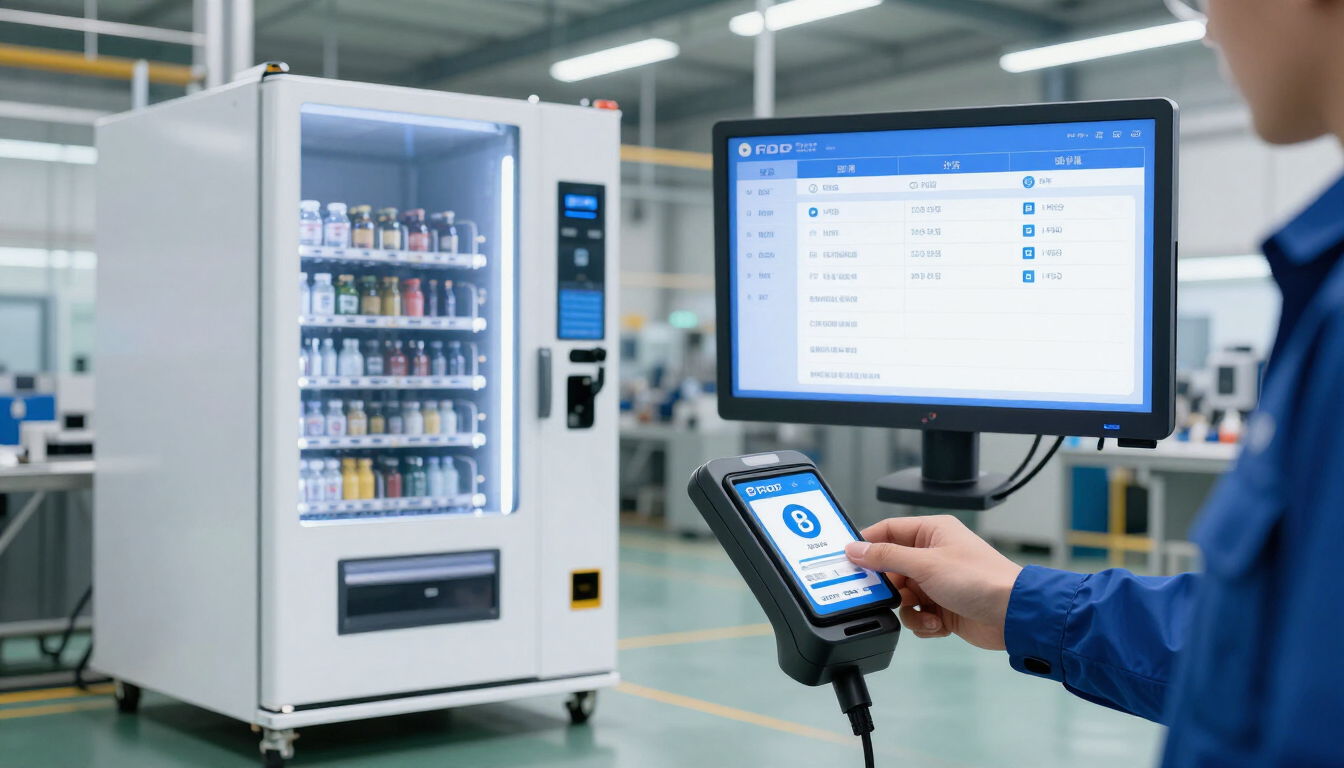
RFID and Industrial Vending: Connecting Physical Inventory with Digital Management
Digital inventory management has become common across modern manufacturing. ERP, WMS and CMMS platforms can record thousands of materials, spare parts and tools. However, one challenge remains: how does a company ensure that the inventory recorded in software accurately reflects what is physically available on the factory floor?
A recent manufacturing case provides an interesting example. According to a September 2026 case study involving Suntory Products in Japan, approximately 24,000 equipment spare-part items at one factory were equipped with RFID labels. The company reported that its spare-parts stocktaking process was reduced from approximately 57 working hours involving 20 people to roughly two hours for one person.
The important lesson is not simply that RFID can make stocktaking faster. It demonstrates a broader change taking place in industrial inventory management: physical materials are increasingly being connected directly with digital inventory systems.
The Gap Between Digital Records and Physical Inventory
Many factories already operate ERP, WMS or maintenance-management systems. These platforms can record:
- Product information
- Inventory quantities
- Purchase history
- Maintenance requirements
- Department usage
- Replenishment records
But software cannot automatically know what has physically happened to an item unless there is a reliable method of recording that transaction. An employee may remove a tool. A maintenance technician may collect a spare part. A box of PPE may be opened. A reusable asset may be returned to the wrong location. Every one of these physical actions can create a difference between system inventory and actual inventory.
This is where technologies such as RFID, barcode scanning and controlled industrial vending become increasingly important.
RFID Provides the Identification Layer
RFID gives physical materials a digital identity. Depending on the application, RFID can be used to identify an employee, a product, a tool or another industrial asset. Instead of relying entirely on manual entry, the system can capture information automatically and associate the physical object with a digital record.
For industrial inventory applications, this can help improve:
- Inventory accuracy
- Asset identification
- Stocktaking efficiency
- Tool tracking
- Transaction records
- Accountability
But identification alone does not solve the complete inventory-management problem. Companies also need to control where and how materials are accessed. That is where industrial vending becomes particularly relevant.
Industrial Vending Adds Controlled Access
An industrial vending machine creates a controlled point between the employee and the inventory. Instead of taking materials directly from an open shelf, the user first identifies themselves through an ID card, NFC, QR code or another authentication method. The system can then determine which materials that employee is authorized to access. Once a product is issued, the transaction can be recorded automatically.
This creates a digital chain:
User → Authentication → Product Access → Transaction → Inventory Update
For frequently used MRO supplies, PPE, cutting tools and industrial consumables, this approach can provide much greater control than conventional open storage.
RFID + Industrial Vending + Software
The next step is connecting these technologies together. A modern industrial inventory architecture may combine:
Identification Layer
RFID, NFC, ID Card, QR Code or Barcode
Physical Inventory Layer
Industrial Vending Machine / Controlled Storage
Control Layer
Android Controller / Local Application
Integration Layer
API
Management Layer
Customer Inventory System / ERP / WMS / Cloud Platform
The industrial vending machine therefore becomes more than a dispensing device. It becomes a physical interface between industrial materials and digital inventory management.
This direction can already be seen across the industrial vending market. Current systems increasingly combine user authentication, connected vending equipment, centralized software and ERP/API integration.
Industrial Vending and Electronic Lockers Are Also Converging
Another development is the combination of vending machines and electronically controlled storage. A recent U.S. Department of Defense procurement for an aircraft maintenance unit, for example, described its requirement as an “Automated Industrial Vending and Electronic Locker System.”
This reflects an important reality. Not every industrial material can be stored in the same type of machine:
- Small consumables may require high-density vending.
- Larger tools may require electronic lockers.
- Reusable assets may require check-out and return processes.
- High-value items may require additional identification and access control.
The future industrial inventory system therefore may not be one machine. It may consist of multiple types of controlled hardware connected to one inventory-management platform.
What This Means for Industrial Vending Hardware
As industrial inventory becomes increasingly digital, vending hardware also needs to become more flexible. Capacity remains important, but customers increasingly need to consider additional questions:
- How will users be identified?
- How will products or assets be identified?
- How will transactions be recorded?
- Can the hardware communicate with existing software?
- Can different storage technologies operate within the same inventory architecture?
At Jiema, our industrial vending hardware is being developed around this integration-oriented approach. Depending on project requirements, configurations can support technologies including ID cards, NFC, QR/barcode scanning, RFID, Android-based control, network connectivity and third-party software integration. For customers operating their own inventory-management platforms, different integration models can also be considered according to the project architecture.
From Inventory Storage to Inventory Intelligence
The evolution of industrial vending is ultimately part of a much larger transformation in manufacturing. Factories are moving from simply storing materials toward understanding: what is available, who is using it, where it is located, when it needs replenishment and how that information connects with the rest of the business.
- RFID provides identification.
- Industrial vending provides controlled physical access.
- APIs provide connectivity.
- ERP, WMS and inventory platforms provide management.
When these layers work together, physical inventory can become part of the digital factory. For industrial distributors, VMI solution providers and software companies, this also creates new opportunities to combine hardware and software into more complete inventory-management solutions.
Jiema provides customizable industrial vending hardware and integration options for international industrial vending and VMI projects. Contact us to discuss your hardware, RFID and software-integration requirements.